 unknown | en

Blog Post
Between Cow and Kitchen
Jan. 7, 2026
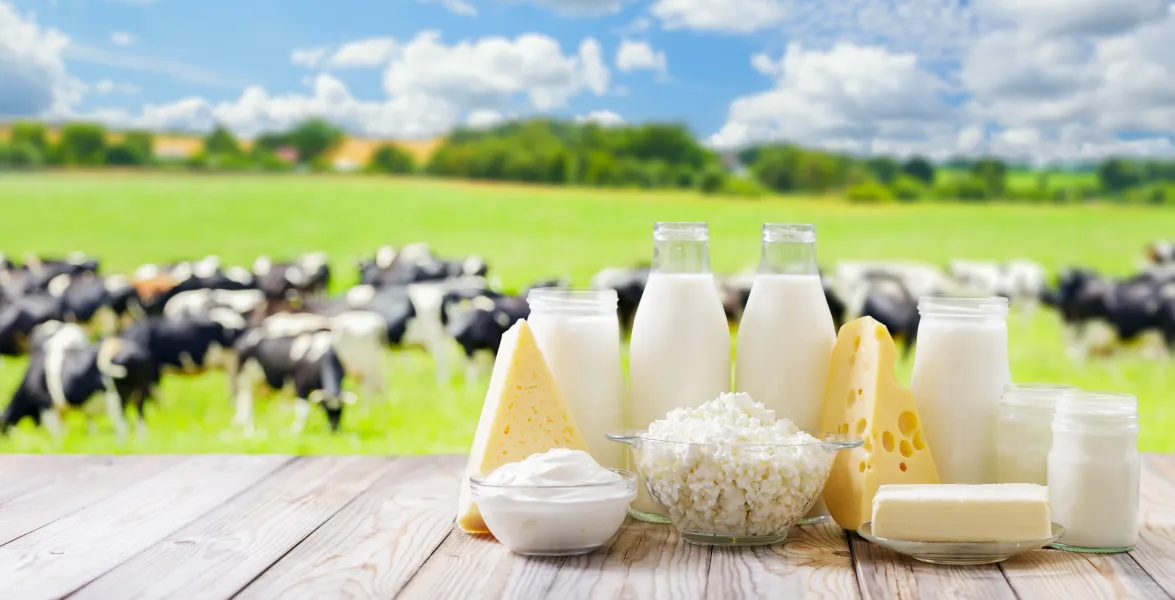
When you pick up a bottle of milk from your supermarket’s refrigerator, it should practically moo. Two days before it was delivered to the store, that milk was still in the cow.
Historically, milk’s perishability has made it among the most local of industries, yet its easy conversion into other foods makes it a significant item of international trade.
The world’s cows produced 674.25 million metric tons of fluid milk in 2024, with India as the top producer, followed by the European Union.
The process that takes raw milk and transforms it into a beverage fit for drinking is pretty much the same all over the world, but that’s where the similarities end. Farm size varies from a single cow to herds of 3,000. Those cows can produce more than 24,000 lb per cow per year, according to the USDA.
Making Milk in a Hurry
The milk that is produced from a cow is 101°F (38°C). It travels through stainless steel pipes to refrigerated vats, where it is cooled and stored between 36°F (2.2°C) and 38°F (3.3°C). Sterile refrigerator tanker trucks then transport the raw milk to the processing plant. These trucks hold 40,000-50,000 lb (18,140-22,680 kg) of milk.
After the truck pulls up to the plant, its load is tested for acceptable levels of bacteria, as well as for fat and protein content and contamination by antibiotics. The raw milk is then pumped through chilled tubes into holding tanks, called silos, which keep the milk below 40°F (4°C).
The raw milk goes through a four-step process—clarification, separation, pasteurization, and homogenization—to become the milk purchased at a local grocery store.
Clarification, performed in a centrifuge, removes bacteria, spores, dirt, and other solids from the milk.
Separation can take place at the same time as clarification. Centrifugal force separates the fat from the skim milk, pulling the less dense fat globules (cream) to the center of the centrifuge, and the denser skim milk to the edges, where it is drained off.
Pasteurization extends the life of the milk by killing harmful, but not all, microorganisms through exposure to heat. Before Louis Pasteur developed the process in the 1860s, drinking contaminated milk often led to sickness or death. Pasteurization involves either heating the milk to 145°F (62.8°C) for at least 30 minutes or to 161°F (71.6°C) for at least 15 seconds.
The boxes of milk that don’t need refrigeration have been completely sterilized through ultra-high temperature (UHT) pasteurization. This process heats the milk to over 200°F (93.3°C) for a few seconds.
According to U.S. Dairy, “The homogenization process—typically involving pumping milk through small openings under high pressure—ensures an even texture, making milk a reliably consistent beverage.” Without being homogenized, the cream in a container of milk would clump together. The proportion of cream reintroduced to skim milk determines whether the final product becomes 1%, 2%, whole, or other types of milk.
Once homogenization is completed, each type of milk goes into a separate refrigerated storage tank before it is packaged.
Curds and Whey
When the spider of nursery rhyme fame spoiled Little Miss Muffet’s meal, she was seated on her tuffet and enjoying a bowl of curds and whey. Today, curds and whey are better known as cottage cheese, made most simply by heating skim milk at a low temperature until it begins to clump, or curdle, and then refrigerating it. The clumps are the curds; the remaining liquid is the whey. (A tuffet is a low stool, by the way.)
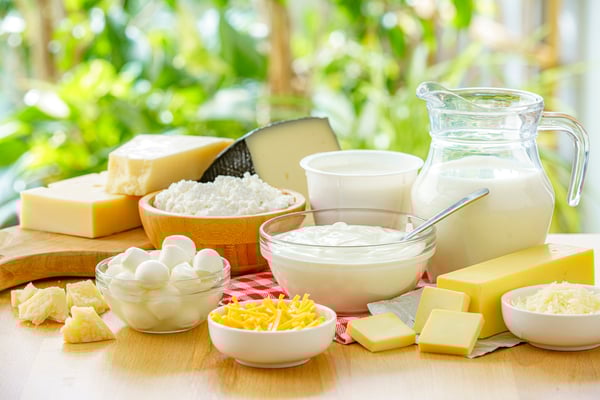 Photo courtesy of iStock, fcafotodigital
Other Products Made From Milk
Cheese begins with curdled milk. The variations in cheese are due to different kinds of bacteria and molds used in production, the level of fat content, and the length of the aging process. It takes 10 lb of milk to make 1 lb (or 4.5 kg to make 0.45 kg) of cheese.
Butter is made by churning fresh cream, with an 80% fat content.
Yogurt is produced by bacterial fermentation.
Cream is the fat that is separated out during the milk production process. In addition to being the major component of butter, it is also processed into heavy cream for whipping (35% fat), cream for coffee (18% or 10% fat), and other products.
Buttermilk has no relation to butter. It is generally made from skim or low-fat milk which is fermented with bacteria that convert milk sugars into lactic acid. The lactic acid is what gives buttermilk its sour taste and thick texture.
Sour cream is made by the same process as buttermilk, but uses cream instead of skim or low-fat milk.
Highly nutritious, universally consumed, and capable of transforming itself into a variety of foods, milk appears to be the indispensable food. Improved transportation and technology will only make it more so. The cow already knows what to do.
Dixon Products for the Dairy Industry
3-A Sanitary Standards were originally developed for the dairy industry but have since expanded into other industries. Dixon’s sanitary valves, pumps, and filtration products are designed to meet 3-A standards to support hygienic operations.
DX60-Series Hygienic Tanker Valve
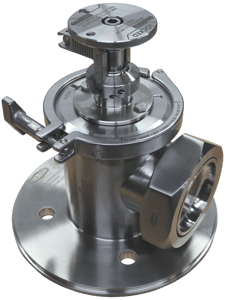
Application
- Loading and unloading milk or cream from tanker trucks
Features
- Easy-lock plunger for locking valve in open position
- Patented closure system to eliminate the pinch point
- Bonnet design uses standard sanitary clamp for easy removal
- Hygienic single-acting wiper seal improves cleanability and durability
Specifications
- Holding pressure: 75 PSI
- Temperature range: -20°F to 212°F (-28.9°C to 100°C)
- Surface finish: ≤ 32Ra
BC/BP-Series Sanitary Centrifugal Pump
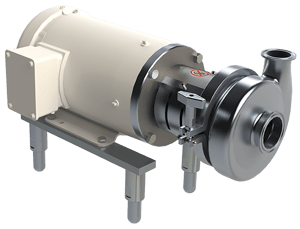
Application
- Low-pressure, high-capacity pumping of milk, whey, or other low-viscosity dairy liquids
Features
- Casing is stamped, not cast, for lighter weight and less porosity
- Safer cage-less guard design
- BC-series features impeller retainer
- BP-series features threaded impeller nut
Specifications
- Nominal capacity up to 1200 GPM
- Temperature range: 32°F (0°C) to 212°F (100°C)
- Nominal speed: 3500 RPM (60 HZ)
- F-seal - cascade flush option for D or DG seal
- 100% CIP-able
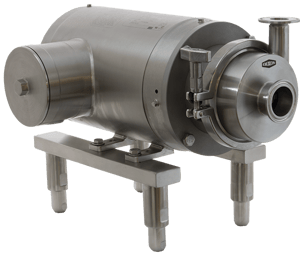
Application
- General purpose transfer of milk, cream, or other dairy products within processing lines
Features
- Uses standard 4” tube clamp for easy removal and adjustment of the casing
- Efficient seal path promotes seal cooling and provides less restrictions to adequately clean the seal
- Sealed impeller provides optimal hygienic performance while the split shaft compression collar improves shaft concentricity, reduces vibration, and improves seal life
- Drop-in replacement for other C-100 series pumps
ExD-Series Sanitary Centrifugal Pump
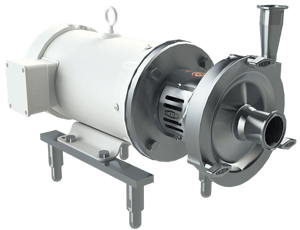
Application
- Transfer of high temperature or viscous dairy products; ideal for pasteurization lines
Features
- Externally balanced seal with clamped in seat
- Unique adapter slots make pump discharge easily adjustable from 90° to 180° without casing or front cover disassembly
- Wet end mounts to a standard NEMA C-face frame motor
Specifications
- Minimum operating temperature: 32°F (0°C)
- Maximum operating temperature: 212°F (100°C)
- Viscosity range: 1-500 cP
- Nominal capacity: up to 500 GPM
- Nominal speed: up to 3500 RPM - 60 Hz

Application
- Gentle handling of milk, yogurt, cream, and other shear-sensitive dairy products
Features
- Bi-wing rotors to maintain efficiency even with low-viscosity products
- 25 Ra finish meeting EHEDG and 3A specifications
- 100% CIP-able
- Stainless steel shims between the gearbox and casing
Specifications
- Front-loading seal options:
- Single (standard) and double mechanical seals, TC vs TC (standard)
- Triple lip seal
- Flush options available on all seal types
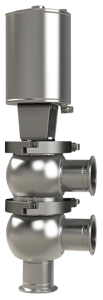
Application
- Diverting or isolating flow in milk and dairy liquid processing lines with full compatibility for CIP procedures
Features
- 3-A certified for CIP
- Available with pneumatic actuator or manual handle
- Burkert™ control top model numbers 8691 and 8692 are available
Specifications
- Standard clamp connections
- Maximum operating temperature: 266°F (130°C)
- Maximum ambient temperature: 140°F (60°C)
- Control air pressure:
- Spring return maximum pressure: 80 PSI (5.5 bar)
- Double acting maximum pressure: 45 PSI (3.1 bar)
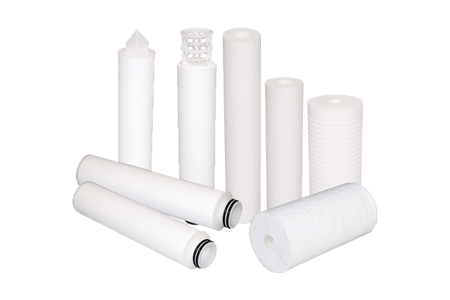
Applications
- Removing particulates from milk, whey, and dairy process fluids to ensure product quality and consistency
Features
- FDA Title 21 compliant
- Cartridge options: melt blown, high efficiency pleated, carbon block, and polyether sulfone
Specifications
- Micron ratings:
- DF-MB-Series: 1, 5, 10, 20, 25, 30, 50, 75, and 100
- DF-PHE-Series: 0.2, 0.45, 1, 3, 5, 10, 25, and 50
- DF-CB-Series: 1, 3, 5, and 10
- DF-PES-Series: 0.1, 0.22, 0.45, 0.6, 0.8, 1.2, and 5
Read Filters and the Purification Process to learn more about Dixon’s sanitary filters.
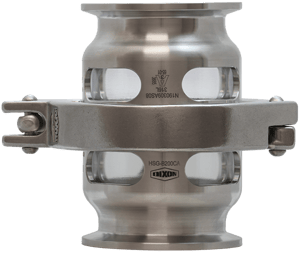
Application
- Visual inspection of milk, cream, or other dairy liquids to monitor flow and product clarity
Features
- 3-A certified for CIP
- Easy to assemble and disassemble
- Patented single clamp construction
Specifications
- Product contact metal components: 316 stainless steel
- Non-product contact metal components: CF8
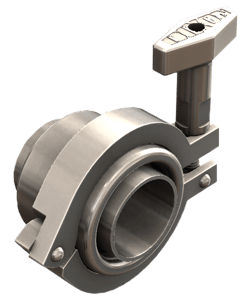
Application
- Provides flexible rotating connection in dairy transfer systems such as milk receiving stations or processing line hookups to help prevent hose kinking and support smooth product flow
Features
- 3-A certified for COP
- Easy assembly/disassembly
- Multiple body styles for greater process flexibility
Specifications
- Maximum pressure at 70°F (21°C)
- 1” and 1-1/2”: 500 PSI
- 2”: 450 PSI
- 2-1/2”: 400 PSI
- 3”: 350 PSI
- 4”: 300 PSI
- Maximum pressure at 200°F (93°C)
- 1” and 1-1/2”: 300 PSI
- 2”: 250 PSI
- 2-1/2”: 200 PSI
- 3”: 175 PSI
- 4”: 150 PSI
Summary
Keeping milk mooving between cow and kitchen is important for producers and consumers. Dixon is delighted to play a role in that process with hygienic solutions for the dairy market. For more information, visit dixonvalve.com or call 877.963.4966.
